Wednesday, August 18, 2010
Kirsten Brown commenting on Haley Jensen's post on The Wizard of Oz
I chose The Wizard of Oz for the same reasons and I felt the same way about the writing. It was descriptive, but open to the imagination at the same time. It was very odd. You got an image from the text that was unique to the reader and his or her feelings at that time, but it did not have every specific detail written down for you to read. Baum drew less on emotion of the reader and instead focused on making it relatable. After reading the book, you have the feeling that the Land of Oz is real and Dorothy really did travel there. You don't feel like you've just finished reading a book.


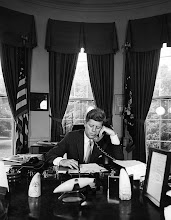
Andrew Fahey President Calling JFK
I thought to listen to JFK, he has always interested me as a President and still is one of the most respected presidents in my eyes. I liked listening to JFK disscuss how he would have handeled the crisis in Mississippi better. Barnett was being very conflictive and said there might be some bloodshed, but they would try to keep the peace. I thought Barnett was completely wrong. He was trying to get out of the blame if anything did happen.
Kirsten Brown- The Presidents Calling
The conversation between President Kennedy and Governor Ross Barnette was particularly interesting to me. The power struggle in the conversation was tense and blatantly obvious. During the first phone conversation Barnette had total control. He gave his opinions and always cut off Kennedy. The president was able to finish very few sentences. In the second conversation President Kennedy begins speaking strongly and firmly. Kennedy gets slightly angry, but Barnette still manages to keep most control. Barnette promises to try and keep peace, but instead, he encourages rioting. At this point Robert Kennedy had to step in and threaten to expose Barnette with conspiracy. During the last conversation, Barnette still tries to weasel into getting his own way, but Kennedy is firm and in complete control. He tells Barnette exactly what he has to do and Barnette tries to get out of it, but Kennedy doesn't sway. The president finally got control over the controversial situation.
Sunday, August 15, 2010
The President Calling: Jessica Dees
I decided to listen the podcast of John F. Kennedy. I have always respected JFK over a lot of different presidents and I thought it would be easy to understand his opinions and thoughts. But unfortunately I was wrong about the understanding part. I realize he was discussing the matter of how he does not believe the Government of Mississippi was at right for a lot of their decisions. But I am still not sure. (I am hoping I will be able to sift through what he really meant after this class.) Anyway, in my opinion I think JFK was stating that the Mississippi government should not punish a student by kicking him out of the University of Mississippi for being black If this is so I completely agree with him because I believe even though other people have prejiduce you should be able to keep your right to obtain knowledge.
Thomas Britton- One Flew Over the Cuckoo's Nest
I initially chose this book for my assignment because my sister already had it. My parents and their friends had also seen the movie and had said good things, so I thought it would be a nice assignment. I really have gotten into the book since then, and I am really enjoying the story. I like how original it is as well, a book about a mental ward with the head nurse as the main villain was a great idea in my opinion. For me the book just keeps getting better and better, and i can't wait to see how it ends!
Ivy Elkins commenting on President Johnson
I had no clue who Johnson was, what period he was from or what he was known for. i thought it was interesting that he was the president of multiple personalities. Knowing that he recorded his phone calls was very interesting which made sense logistically but also seemed kind of shady. Once i listened to how he felt about MLK and the whole expansion on the civil rights movement i realized it was intelligent so that he could have proof of peoples words and hold them accountable. I thought it was very admirable. I also thought he was a heroic man for wanting to encourage Jackie in her time of need since she had just had her whole life turned upside down. He didnt want to make her talk about politics or tell her how great of a president he would be, but he told her how he was always going to be her friend. He also mentioned how women are so strong which also was a part of the encouragement to the expansion on the civil rights movement. Im still not sure how i feel about him totally but i think he was definitely very interesting since he was originally under one of the most famous presidents. He obviouslly learned a lot and used that along with his own view to influence Vietnam. But i do think it was wise of him not to run for re-election since he had such a tricky presidency that was so much different in the times and events that were happening to America and their relationship with everyone at that time.
René Michaud: President Calling
I would first like to say, I would much rather listen to JFK to presidents of my generation. I was actually kind of intrigued by what he had to say and seemed to be a man of honor and was set on doing the right thing. But to contrast of JFK, the governor stuck me as closeminded, racist man. The podcast "JFK Persuades Barnett to maintain law and order in Mississippi" is pretty much JFK trying to get Barnett to admit Meredith, but Barnett is reluctant because of fear of not being to control mobs. In the end, Meredith was safely registered.
As to the podcasts, I like how simple it was to find and its ease of use. But for those who don't have itunes and are unable to download it, it may be quite inconvienient. I do like this source also for the fact that it is primary and will be very helpful in the future.
As to the podcasts, I like how simple it was to find and its ease of use. But for those who don't have itunes and are unable to download it, it may be quite inconvienient. I do like this source also for the fact that it is primary and will be very helpful in the future.
Raquel Littlefield - The President Calling: Nixon
I listened to President Richard Nixon's recordings. First off, I honestly did not know too much about this president, but I did learn that he was a republican who was elected in 1968 which was in the middle of the Vietnam War. Nixon was a shy, introverted man who was also cynical and very profane.
I disliked his quote about Africans stating that they do not "measure up" to them. However, I found this contradictory to his slogan during the elections. His slogan was, "Bring us together" which obviously contradicts his statement about the Africans he made later. I don't quite understand why he would say something like this, even though he was raised by his mother's moral values. Perhaps his mother's moral values were different than the values I believe in.
Then in 1973, at a conference about the Watergate Scandal, Nixon felt self-pity due to the fact that two of his people resigned. I would feel the same way if that happened to me. Anyway, this eventually lead to Nixon's resignation. He was the first president to resign in office. After his resignation, the secret recordings came to a halt.
All in all, I actually enjoyed listening to this podcast. I'm usually not all that great at sitting and listening to a podcast, but surprisingly I could handle this one and I did learn quite a bit from it.
Kelly Overstreet: The President Calling- Nixon
I chose to listen to Nixon's address to the nation regarding the very recent Watergate scandal. It was still in its early stages and I found it very interesting how Nixon said he would take responsibility for the poor actions of his advisers when he later would. He seemed to be very concerned about the seriousness of their actions. I also noticed how towards the end of his speech he attempted to draw attention away from the Watergate scandal by discussing meetings with the Soviets and inflation in the economy.
I like the idea of using podcasts as a learning source, as we usually have to do enough reading for other classes and it would be a nice way to change things up.
I like the idea of using podcasts as a learning source, as we usually have to do enough reading for other classes and it would be a nice way to change things up.
John Thyer - The President Calling Podcast
I just completed my podcasts, and I'd like to share my thoughts on what I heard from the mouth of John F. Kennedy himself.
First off, I'd like to say that this assignment was very interesting, and it was very humanizing to listen to the actual voice of JFK, a president from half a century ago, and hearing his words against the Government of Mississippi was fascinating. Secondly, I'd like to say that I hate iTunes with a passion and that I resent having to install it but anyway...
The first Podcast I listened too was the "JFK Debates Govenor's Decision to Ban James Meredith from U-Miss" file. In it, JFK debates with the Governor (of Mississippi, I assume) about their decision to bar James Meredith from the University of Mississippi. The Governor states that Meredith has committed a state crime, and is therefore barred from entering state schools. Upon further research (read: Wikipedia), I found out that this law was enacted around the time that James Meredith sued the University of Mississippi for refusing to admit him due to his race. The law was essentially created to block Meredith, who was formerly charged with voter fraud. JFK argues for Meredith to be admitted, while the Governor says his duty is to uphold the law.
The second podcast, "JFK Persuades Barnett to Maintain Law and Order in Mississippi", involves the Governor trying to convince JFK to avoid registering Meredith, as he might not be able to stop mobs and the like from developing in opposition to Meredith's admittance. JFK asks that, if he waits for the people to cool down, will Meredith be admitted, and the Governor reluctantly agrees.
The third and final podcast I listened to was the "JFK Addresses Nation Prematurely on Success in Mississippi" file. In it, JFK delivers a speech to the nation about the success in Mississippi and how it could have happened sooner had the state government of Mississippi upheld Federal law rather than resisting it. This final speech is interesting, as, while it rightfully chastizes the Mississippi state government for its actions, it also is a total condemnation of civil disobedience. Listening to his words, he essentially condemns the works of Gandhi and many African-American civil rights activities that happened before and during his presidency.
I obviously agree with JFK's assistance of the civil rights movement and I feel that he's a moral man, but I don't believe I can morally side with him on the issue of civil disobedience. Civil Disobedience is a just and righteous tool for fighting corrupt governments, and his attack on the whole movement is in the moral wrong, in my opinion of course.
Unrelated to this but related to the other assignment, I just watched the "One Flew Over the Cuckoo's Nest" film, and it was just as fantastic as I'd hoped. One thing that was interesting however, was that the book had a better Nurse character and gave me much more time to despise her, the movie version of McMurphy as played by Jack Nicholson is far superior thanks to Nicholson's fantastic performance. I think that I would have enjoyed the film more if I'd seen it first, but then I doubt I'd have enjoyed the book as much. Both experiences would have been enriched if I hadn't had the ending spoiled by my little brother. Jerk.
Also, something else sprung into my mind recently. Now, I hate to use the term "ripoff", but, try reading/watching One Flew Over the Cuckoo's Nest and then reading/watching Harry Potter and the Order of the Phoenix and see who Dolores Umbridge reminds you of. Just saying.
Jessica Dees: Response to Rene Michaud
Rene I’m going to have to say that the Band of Brothers sounds like a pretty cool book. The movie is never better than the book. They always leave out to much. The whole thing about the real soldiers being interviewed I think is really interesting. I have always loved hearing stories in the first perspective, especially when it’s about war stories.
The Things they Carried: Jessica Dees
The things they carried were beyond an interesting book. What caught me off guard though was that it wasn’t anything like an ordinary book. Instead of having one big story there was many different short stories put together in no particular order. I never really knew when Tim O’Brian was telling a true story or not or if the people were real. I loved hearing about his characters like Rat Kiley and Norman Bowker, until most of them died. In some parts of the book it was very graphic which really made me realize how the war was very unforgiving. But to me it is the most interesting topic to learn about.
René Michaud: Band of Brothers
I chose to read Band of Brothers because I enjoyed the HBO series quite a bit. The book and the series were pretty much the same to the last detail(makes sense to me), except for the fact the movie did not include nearly as much as the book. It took place during WWII following E company, 506th Regiment, 101st Airborne who were considered the most physically fit regiment. This book was much better than I had expected. I thought it was pretty cool that a lot of the real soldeiers were interviewed and Ambrose used quotes throughout the book. I really enjoyed this book and would recommend it to anyone who enjoys WWII books.
Ryan O'Meara: JFK the President Calling
For my "The President Calling" assignment I chose to listen to JFK's stance on the banning of James Meredith from the University of Mississippi. I listened to the president's conversations with the governor of Mississippi, along with a speech to the American people addressing what was going on. To me, the president seems to be a man of his honor while he is fighting for James Meredith, but I think that the governor on the other hand was working as a politician. The governor seemed to be resisting the president and it seemed as if he didn't want to step up and handle the situation. Some parts of the phone calls between the two seemed to be heated as they could not reach a common solution to the problem.
I enjoyed listening to the podcasts, and I hope to see them used in the up coming course. It felt good to be able to listen to a primary source instead of having to read it. The ease of being able to access the source also adds to why I like it, because the download only takes a second, and above all it's free! In addition, it cuts down on the number of papers that I have to carry around and keep track of, and let's face it: we all have enough to keep track of as it is.
I enjoyed listening to the podcasts, and I hope to see them used in the up coming course. It felt good to be able to listen to a primary source instead of having to read it. The ease of being able to access the source also adds to why I like it, because the download only takes a second, and above all it's free! In addition, it cuts down on the number of papers that I have to carry around and keep track of, and let's face it: we all have enough to keep track of as it is.
grace stoyshich-president calling
well i must say that history is not my best subject which is why im taking this class. i listened to the recording and personally understood about 40 % of it. i really learned to respect kennedy and his decisions i think it was really honorable of him that he called and asked eisenhower for advice on the cuban missile crisis. i think the idea of listening to these recordings and it being open to the public is an excellent. i think for people like me that are not from the USA and dont have much knowledge on US history that this would be something useful and informational to listen to. i learned alot from the recordings and i believe that kennedy was a great president and that he wasnt perfect but he always trie dto make decisions that would help the people of the united states. i thought it was crazy for Nixon to say that he was happier to hear Kennedy's voice than jesus's lol kinda blew me away that he would say that, maybe he wasn't very religious or maybe it was just a bad joke. anyway i did enjoy the tapes. i had to listen closely and i look forward to learning more about it.
grace stoyshich
well i read the wizard of Oz and watched the movie and personally the book was waaay better compared to the movie. there were too many differences in the movie. i really enjoyed reading the book. it was exciting. my book had pictures in it which were fun lol but i would defiantely recommend it to someone else. it was awesome!
Haley Jensen: the president calling-President Kennedy
HALEY JENSEN
Personally, I think John F. Kennedy was one of the best presidents the United States of America has ever had. To me, President Kennedy seemed a fair and honest man. He knew what he had to do and knew the price he might have to pay but despite those conditions, he was still going to do what was right but he wanted to do so in a peaceful, non troublesome way. With the situation in Mississippi, JFK knew that he could lose votes from the southern people and knew that it was a risk for the next election but he also knew that he had duties to carry out with James Merideth and his rights as a human being. In which the Declaration of Independence states, "All men are created equal", and I think that had to do some with JFK's initial decision on trying to allow James Merideth to register for his classes at Ole Miss' where there was segregation and racism against James Merideth and he was denied access to go into the school and register for his classes. I also think that Govenor Barnett was a racist individual and it seemed to me like he had no respect for the president. President Kennedy wanted to solve it peacefully so nobody would get hurt or killed and it would be a non violent thing but Govenor Barnett was two face and would go behind the presidents back and say one thing to the president but then say something else to other people.(ex:the transcripts I voluntarily read between Governor Barnett and Attorney General Kennedy). I think President Kennedy did the best he could in keeping the United States under control and keeping things done in an orderly,peacefully manner but people were defiant and recalcitrant, which made it difficult on the president to keep things controlled in a peaceful manner all the time.
Personally, I think John F. Kennedy was one of the best presidents the United States of America has ever had. To me, President Kennedy seemed a fair and honest man. He knew what he had to do and knew the price he might have to pay but despite those conditions, he was still going to do what was right but he wanted to do so in a peaceful, non troublesome way. With the situation in Mississippi, JFK knew that he could lose votes from the southern people and knew that it was a risk for the next election but he also knew that he had duties to carry out with James Merideth and his rights as a human being. In which the Declaration of Independence states, "All men are created equal", and I think that had to do some with JFK's initial decision on trying to allow James Merideth to register for his classes at Ole Miss' where there was segregation and racism against James Merideth and he was denied access to go into the school and register for his classes. I also think that Govenor Barnett was a racist individual and it seemed to me like he had no respect for the president. President Kennedy wanted to solve it peacefully so nobody would get hurt or killed and it would be a non violent thing but Govenor Barnett was two face and would go behind the presidents back and say one thing to the president but then say something else to other people.(ex:the transcripts I voluntarily read between Governor Barnett and Attorney General Kennedy). I think President Kennedy did the best he could in keeping the United States under control and keeping things done in an orderly,peacefully manner but people were defiant and recalcitrant, which made it difficult on the president to keep things controlled in a peaceful manner all the time.
Jennifer Rudder- The President Calling: Lyndon Johnson
First of all, I think it was pretty cool that Johnson was sworn in after being Kennedy's vice president in the event of Kennedy's death. When he was sworn in, he already had a lot of experience with politics. When the podcast talked about his different personalities, it made me want to listen more intently to find out what exactly they meant by it. I really loved that he called Jackie Kennedy and told her about how much courage women have. The listener can really tell how he was able to cheer Jackie up while she was mourning the loss of her president. He seems genuinely concerned and sympathetic towards her, but it is apparent that he wants her friendship in order look good to the public. I think it was pretty wise of him to tape all of his conversations so that he could hold people accountable to their word. I kind of like the "shocking" methods he used. To me, it shows that he is a real person and he isn't going to promise something he can't deliver. On the other hand, it makes me think that he sometimes does put on a fake-front in order to get what he wants or to win someone over. I like that Johnson basically ignored Hoover's hate towards Martin Luther King Jr. and how he actually encouraged King Jr. When all the drama with the Vietnam had somewhat settled, he decided not to run for re-election.
After listening to the podcast, I have mixed feelings about Johnson. There are some aspects of his personality, morals, and political views that I strongly disagree with. But for the most part, I respect Johnson's strong personality. He really stepped up to the job when Kennedy passed. Although there are many views on his personality, I think that he did what he needed to do. If it weren't for his strong personality and sometimes harsh ways, he might not have gotten as many things accomplished.
After listening to the podcast, I have mixed feelings about Johnson. There are some aspects of his personality, morals, and political views that I strongly disagree with. But for the most part, I respect Johnson's strong personality. He really stepped up to the job when Kennedy passed. Although there are many views on his personality, I think that he did what he needed to do. If it weren't for his strong personality and sometimes harsh ways, he might not have gotten as many things accomplished.
Jessie Bono in response to Lindsey Langston's post:
Although I chose to go with Ken Kesey's book on the "Option A" list (a book in which I highly recommend reading), if I had chosen "Option B," I would have gone with this book. It sounded truly inspiring (as I can see by Lindsey's response). I, too, am interested in the Civil Rights Movement and, sadly, don't know enough about it. I would have done this assignment if I had any clue how to use Google Earth.
Jessie Bono on President Calling -- Lyndon Johnson
I chose to listen to the podcast of President Lyndon Johnson. Honestly, I’d heard of President John F. Kennedy and of President Nixon, but I only vaguely recall hearing of President Lyndon Johnson. I think technology is amazing nowadays, that I can listen to the past on my iTouch or computer. It’s just mindblowing to think that years ago, when my 23-year-old brother studied President Johnson or Nixon or Kennedy, he studied their speeches from textbooks or heard the main topics during lectures. I get to hear their voices in person, hear the tone, hear the eloquence. It makes me feel lucky.
Anyways, after listening to the podcast of President Johnson (the speech he made to Congress and his phone conversations), I must say he sounds more like a politician than a man of honor. Even though he had the difficult task of following a man like President Kennedy, he comes across (to me) as a bit manipulative in the use of his “shock techniques” and the phrases and words he uses to describe situations America was going through doing the time. He seemed charismatic and powerful, but I don’t like how manipulative he came across as. It seems that he used his charisma to make things go his way.
Anyways, after listening to the podcast of President Johnson (the speech he made to Congress and his phone conversations), I must say he sounds more like a politician than a man of honor. Even though he had the difficult task of following a man like President Kennedy, he comes across (to me) as a bit manipulative in the use of his “shock techniques” and the phrases and words he uses to describe situations America was going through doing the time. He seemed charismatic and powerful, but I don’t like how manipulative he came across as. It seems that he used his charisma to make things go his way.
Subscribe to:
Posts (Atom)