Sunday, August 11, 2013
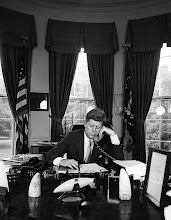
Kennedy Nelson-The President Calling, John F. Kennedy's Personality
I chose to comment on John F. Kennedy's section on the Presidents calling. In terms of leadership, I Kennedy handles extreme situations very well. During an intense time in Mississippi, Kennedy faced an incoming riot based on the banning of James Meredith who was an African American man. I admired Kennedy's way of talking to others under stress. In this situation, Kennedy spoke on the phone to Mississippi governor Ross Barnet who was in the middle of this mess. Although, he did not exactly had a hand on the problem at the beginning, Kennedy still sounded in command. He helped guide Barnet using his easy to trust vibe. He was never unsure of how to manage. He also was not anxious or bossy. Even in other parts of Kennedy's section, he was still calm and had a great, easy to talk to personality.


Serena Ramos: The President Calling JFK
JFK is persuading Barnett to Maintain Law and Order in Mississippi. President Kennedy is concerned for the well being of the people of Mississippi and he wants to make sure that the police maintain law and order in a discrete and orderly manor so nobody gets harmed and not much if at all no damage is done to Mississippi. This shows that Kennedy cares for his people and wants to protect them and his country.
Ashlee Trusik - The President Calling
I listened to the conversations of President Kennedy on the Mississippi Crisis. In September, 1962, Governor of Mississippi, Ross Barnet, blocked a black man from enrolling at the University of Mississippi, otherwise known as Ole Miss. Throughout a series of taped phone calls President Kennedy tried to convince Governor Barnett to let Jams Meredith enroll at Ole Miss. He tried to convince him without the use of violence, because that would cost him votes in the South. The word about the situation got around and racist around America grabbed their guns and headed for Oxford. The attorney general eventually blackmailed Barnett into letting Meredith enroll into Ole Miss. I think Kennedys decision to not address the situation with violence the best decision to make, not only because it would cost him votes, but because it would've made the situation worse. When things get violent, everybody gets rowdy and decide to join in and next thin you know you have a violent outbreak on your hands. President Kennedy handles the situation in the best way possible.
Kristin Cohea: The President Calling
I listened to Nixon speak with John Mitchell, specifically focusing on his relationship with the press. While I didn't know much about Nixon and his terms in office besides the Watergate incident and that he was the only president to resign, shortly before he was the only president to be impeached at the time, I was curious as to why this man was so disliked. The specific podcasts I listened to was his conversation- presumably private- that he had with Mitchell about 'duping the press' after they had gotten hold of the names he intended on appointing to the supreme court. He told Mitchell to send them 'twelve more names, just to keep them confused'. But it wasn't so much of the subject that got my attention, it was the president, and the way he talked about it, that irked me. Half the time Mitchell began to speak, Nixon interrupted. He threw words around that seemed extremely rude to me, calling some of the people he intended to give the press 'sanctimonious assholes', telling Mitchell to send the media names of 'Jews or women, I don't really give a damn who.'
From the very beginning of the conversation he just sounded manipulative.
From the very beginning of the conversation he just sounded manipulative.
Jake Vancore- Presidential Calling JFK
I decided to listen to the podcast of JFK and Governor Barnett discussing the conflict of James Meredith enrolling into Ole Miss. Their discussion was about James Meredith, an African American man, not being allowed to register to Ole Miss. People were protesting and not letting the young man register and President Kennedy called up Mississippi Governor Barnett to cooperate with the federal order President Kennedy was given to tell Governor Barnett to let the man register. Governor Barnett however told JFK that he had to abide with his own state's law and wouldn't comply. JFK then called him and discussed what to do make things work. I liked the way JFK handled this situation because he made it as most non-bias as possible so that Governor Barnett felt like the President was just being forced to comply orders. He also made it sound like he just wanted to make sure everything would be safe and that no harm would come to anyone. President Kennedy did a good job in my opinion of containing the situation and not having excessive violence break out.
Erin Goad- The President Calling
I chose to listen to President Lyndon Johnson's phone call to Jackie Kennedy, Richard Russell, and Robert McNamara. By listening to these phone calls, one is able to determine that Johnson was very influential. When talking to Russell, Johnson flat out told him that he was now part of the commission despite what he said to decline. After talking Johnson is able to convince Russell that he will do a good job based on the fact that he is an American. Another phone call to Jackie Kennedy shows Johnson skill in talking to people and interacting with them. To me, this is a very important quality in a president, to be able to speak to a crowd and make them believe you.
Mallory Glenn- The President Calling
I decided to listen to the podcast between John F. Kennedy and Governor Barnett of Mississippi. Their conversation was about James Meredith, a colored man who wasn't allowed admission into Ole Miss. President Kennedy wanted Governor Barnett to allow Meredith into Ole Miss and to control the raging crowds of people who did not want an African American to attend the university. I admire how President Kennedy was able to make Governor Barnett do what he wanted him to do without causing any conflict. At the beginning of the "secret agreement" between the president and the governor, Kennedy felt like Barnett was trying to take advantage of him by not doing what he wanted; but when President Kennedy threatened to expose their "secret agreement" he was able to get Barnett to do what he wanted. I admire President Kennedy's ability to do this because he was able to make Governor Barnett follow his instruction without making the governor unhappy.
Hunter Scott- Mississippi Crisis
I listened to the Mississippi crisis, a dilemma regarding the federal and Mississippi state powers verbally disputing whether or not to let James Meredith, a young African American man, register for Ole' Miss college. President John F. Kennedy and the supreme court had both decided that Mr. Meredith was to be allowed to register for Ole' Miss but the Mississippi Governor, Ross Barnett, had other plans. Governor Barnett said that the supreme courts decision to let Mr. Meredith register went against Mississippi's segregation laws. This was the point in which President Kennedy decided to intervene, where he had many phone calls with Governor Barnett. In these phone calls Kennedy and Barnett both came up with solutions to their dispute through words instead of violence. My opinion is that the solution that they came to agree to was the best possible as James Meredith was aloud to register and no one was hurt.
Justin Bartell- The President Calling: Richard Nixon
I listened to Richard Nixon's Bombing for Peace Callings. These were a variety of conversations over the issue of the Vietnam War. The first three conversations (with Melvin Laird, Ken Rush, and Thomas Moorer) was simply a discussion of Nixon's new war decision: to mine the Hanoi and Haiphong Harbors. Before these conversations, he gave a speech to the public discussing the rationale of this wartime development. The first three people all agreed with Nixon in his new plans and zeal to be more aggressive with the Vietnam War. Melvin Laird was the Defense Secretary and was told by Nixon to be more "hawkish" even more than Nixon himself. Laird simply agreed to everything Nixon said and promised his support. Ken Rush was the Ambassador to Germany who also agreed with Nixon's speech. Nixon told Rush how to specifically word his defense on the mining and counter-offensive efforts. Thomas Moorer was the Chairman of the Joint Chiefs of Staff. Nixon simply stressed that the bombings be executed flawlessly and that there is no excuse that it shouldn't be executed perfectly. Through these first three calls Nixon's zeal in the Vietnam War was displayed, as he kept pushing everyone to get the public on his side and to the success of the counter-offensive. Additionally, he kept interrupting these three people when they were on the phone. This displayed how he always got quick to business and further supports his zeal in the war.
The morning after these calls (and after his speech), he talked to Attorney General John Mitchell about the public reaction to his speech. Mitchell discussed how there was a resounding agreement from the public in Nixon's speech and reaction. He then discussed getting the support of other men.
A week later, Nixon talked with national security affairs advisor Alexander Haig about propaganda. Nixon simply asked what everyone was doing in the regard of scaring the enemy through bluffing. He talked about how it isn't the time for truth because this is war. Nixon discussed how the propaganda side of this war effort has been very weak and therefore needs to be used since the tide of war might be turning.
His conversations all displayed the need to manipulate the throng of people through language and positions. He worried about the public opinion and how to specifically word the counter-offensive to win public opinion and wanted more focus on propaganda. These all display his political, manipulative tactics so that the war effort may be strengthened and continued, displaying his power in manipulation through political language. The entire conversations were interesting to listen to as it displayed that the Presidents talk just as normal people do and allowed me to try to understand Nixon and his behavior, even after all these years.
The morning after these calls (and after his speech), he talked to Attorney General John Mitchell about the public reaction to his speech. Mitchell discussed how there was a resounding agreement from the public in Nixon's speech and reaction. He then discussed getting the support of other men.
A week later, Nixon talked with national security affairs advisor Alexander Haig about propaganda. Nixon simply asked what everyone was doing in the regard of scaring the enemy through bluffing. He talked about how it isn't the time for truth because this is war. Nixon discussed how the propaganda side of this war effort has been very weak and therefore needs to be used since the tide of war might be turning.
His conversations all displayed the need to manipulate the throng of people through language and positions. He worried about the public opinion and how to specifically word the counter-offensive to win public opinion and wanted more focus on propaganda. These all display his political, manipulative tactics so that the war effort may be strengthened and continued, displaying his power in manipulation through political language. The entire conversations were interesting to listen to as it displayed that the Presidents talk just as normal people do and allowed me to try to understand Nixon and his behavior, even after all these years.
Hunter Sheffield - The President Calling LBJ MLK
I listened to President Lyndon B. Johnson talk to Civil Rights Leader Martin
Luther King Jr. and FBI Director J. Edgar Hoover. During the conversation
between LBJ and MLK they seemed to discuss how to get the voting rights bill
passes. Johnson asked for King's help in getting Americans to see the wide
discrimination against blacks that wanted to vote so they could see that it
wasn't right and would want to make a change. So Martin Luther King Jr.
organized a march to Montgomery from Selma, which resulted in "Bloody Sunday."
Even after this occured MLK still had more marches organized and on one of these marches led to the death of a women named Viola Liuzzo, a white
women. She was killed by some members of the Ku Klux Klan while she was driving
a black man home from one of the marches. After her death, President Lyndon B.
Johnson and J. Edgar Hoover talked about how the FBI caught the people that
killed her. In my opinion it was good that MLK had these marches in order to stand up for the wide discrmination against blacks and to give them voting rites as well.
Kathleen "Haley" Jacobs
I listened to the JFK Mississippi crisis, where he discussed with Governor Barnett the issue of enrolling James Merideth, an African American student, into the University of Mississippi. The U.S. Supreme Court had already ruled in Merideth's favor and allowed for him to enroll into the school but Barnett argued that he "would not surrender to the evil and illegal forces of tyranny." It was Kennedy's job to argue with Barnett using vocalization rather than the harsh and forceful methods of violence so that he would not lose precious voters support in the south. It is my opinion that Kennedy handled this matter fairly well because he was able to sway Barnett over a series of multiple phone calls and got him to concede and allow for Merideth to attend Ole' Miss.
Lauryn Gressel-The President Calling
I listened to, “Nixon Addresses Nation Regarding Scandal”.
In this speech Nixon talks about the Watergate scandal, which happened in the
year 1972. As Nixon starts off his speech he talks about the election and how appalled
he is when he hears that White House members could have been involved. After
stating that he goes on and talks about how he will do everything in his power
to find the White House member who were involve, and says that anyone who
refuses to cooperate has to resign. He
then says that two of his close workmates have already resigned. To start out
the investigation he hires Elliot Richardson to collect all the facts and report
them straight to him. All he wanted was peace for America, and peace for the
World. Many people looked at the Watergate scandal as bankruptcy for America,
but Nixon had a different view, he looked at it as illegal acts and bad judgment
by many individuals. He wanted to protect the innocent and convict the guilty.
He said that Elliot would be fair and fearless when taking on this case. At the close end of the speech he told the
listeners how many days he had left in office, 1361, and he wanted those days
to be the best days in America’s history. He closes his speech with, “God bless
America and God bless each and every one of you.”
My opinion on the situation that Nixon had to deal with is
that he dealt with it in a fair way and did what he had to do to get the guilty
party. As Nixon’s career went on, he ended up resigning in the year 1974, after
he had heard that Congress was going to impeach him.
Tori Holloman: The President Calling
I listened to President Lyndon B. Johnson talk to Civil Rights Leader Martin Luther King Jr. and FBI Director J. Edgar Hoover. During the conversation between LBJ and MLK they seemed to discuss how to get the voting rights bill passes. Johnson asked for King's help in getting Americans to see the wide discrimination against blacks that wanted to vote so they could see that it wasn't right and would want to make a change. So Martin Luther King Jr. organized a march to Montgomery from Selma, which resulted in "Bloody Sunday." Even though "Bloody Sunday" occurred, King decided to organize more marches and one of these marches led to the death of a women named Viola Liuzzo, a white women. She was killed by some members of the Ku Klux Klan while she was driving a black man home from one of the marches. After her death, President Lyndon B. Johnson and J. Edgar Hoover talked about how the FBI caught the people that killed her. In my eyes, it was a good idea that MLK organized more marches after "Bloody Sunday" even though many people tried to stop him. The marches seemed to help with the passing of the voting rights bill and it thought it was interesting how the FBI caught the murders of Viola Liuzzo.
Saturday, August 10, 2013
Katherine Maxwell- JFK
I decided to listen to the podcast with President John F. Kennedy and Governor Barnett of Mississippi discussing James Meredith, a colored man denied acceptance to the University of Mississippi. The Supreme Court decision was causing all kinds of uproar and President Kennedy wanted the Governor to control the riots to prevent violence. Next I listened to the President addressing the nation about the problems in Mississippi, he was very concerned about the well being of Meredith and the safety of the citizens of Mississippi. This showed me that Kennedy was a kind man and really cared about civil rights, he wanted his country to be safe and all the people to have equality.
The Presidents Calling - Gabrielle McCray
I chose to listen to the conversations between President John F. Kennedy and Governor Barnett. These conversations were based upon the subject of James
Meridith and the problems concerning segregation in Mississippi at that
time. Because Kennedy was against segregation, Kennedy tried to implement his executive power to ensure that Meridith was peacefully accepted in the midst of the violent crowds. I think Kennedy handled this situation well because he was able to get Meridith accepted into college without causing such a violent uproar.
The Presidents Calling - Sean O'Halloran
I listened to the conversations between JFK and Governor Barnett of Mississippi regarding Merideth who was trying to attend the university of Ole Miss. I found it interesting how these conversations showed the colliding powers of the state and federal government. Although they were both callborating for a common goal, they had to do so while fulfilling the obligations of their branch of governement. I think Kennedy should have put more trust into the Governor in those situations instead of undermining his ability to resolve issues within his own state.
Kyra Samaha- The President Calling
I chose to listen to President Nixon's telephone conversations because I feel like he was a very important figure and leader during the 1970's. During his conversations he isn't afraid of masking what he wants to say; and emotions thereof. Especially in his discussion with Alexander Haig on military tactics for the Vietnam War, President Nixon clearly states that he wants to terrify the Northern Vietnamese with more B52 planes, all to aid the Southern Vietnamese. It was a bold call, and he made it without any hesitation; therefore, he knew what would help the Anti-Communist countries the most. Nixon also decided that in order for the battle to turn, the level of propoganda had to increase in order to have the best result for the Vietnam War. President Richard Nixon was considered a controversial figure in America and around the world.
Kimberly Greenwood - The Presidents CAlling - LBJ speaks to Congress
I listened to LBJ speaking to Congress. LBJ talked about justice and equality after first saying a few words about JFK. He spoke at length about finding strength in the differences instead of weakness and then calls upon the American citizens to help him in reaching the goals and show that they are capable of 'decisive action' and in even so soon after the assassination of JFK they will derive strength and not weakness and he then dedicates the US's support to the United Nations and makes a firm promise to defend their allies and also keep the stability of the dollar, expand international trade and make America and its allies stronger. He speaks about continuing JFK's course and 'fulfill the destiny history has set for us.'
He spoke very clearly and very well in order to affirm the American people and the members of Congress, trying to motivate them to continue after JFK's assassination. He continually uses the idea of strength and continuing JFK's legacy as a motivator to rid the US of discrimination against races. He tactfully proposes the bills and calls Congress to action in swiftly accepting the bills. JFK's legacy and the strength of the US is the fulcrum of his speech in order to motivate Congress. He was a very good speaker and seemed very firm in his beliefs. He clearly made a profound impression on Congress.
He spoke very clearly and very well in order to affirm the American people and the members of Congress, trying to motivate them to continue after JFK's assassination. He continually uses the idea of strength and continuing JFK's legacy as a motivator to rid the US of discrimination against races. He tactfully proposes the bills and calls Congress to action in swiftly accepting the bills. JFK's legacy and the strength of the US is the fulcrum of his speech in order to motivate Congress. He was a very good speaker and seemed very firm in his beliefs. He clearly made a profound impression on Congress.
Jodi-Ann Bradley- The Presidents Calling JFK
I listened to John F. Kennedy and the Mississippi crisis, I saw that many people easy persuaded John F. Kennedy's hand in many issues. For example when he had the conversation with Eisenhower about the possibility of the Cuba starting a nuclear war with the U.S if they were to invade, John f. Kennedy was easily persuaded by Eisenhower to believe that the Cubans wouldn't start a nuclear war if they were to invade. Instead of defending his ideas on the situation he chuckles and says I will still keep me men on alert. Although he did not get persuaded when he sent lightly armed US marshals with suites and gas mask to Mississippi. Also I found that he was being controlled by General Barnett up until the point when General Barnett does not keep order in Mississippi and secretly negotiates with the Kennedy's to step aside when Federal Marshals arrive with Meredith and General Barnett gives a disobedient speech on September 29th at a football game before he steps down. Though John F. Kennedy handled this situation nicely when he threatened to tell the world that Ross Barnett was negotiating with the Kennedy which would kill him politically. This all causes John F. Kennedy to take back control when he had Barnett stand down and forced the troops into Mississippi to kill the riots which caused James Meredith's registration to the University of Mississippi.
Shane Smith - The President Calling Comment
I chose to
listen to the podcast clip titled “Lyndon B.
Johnson Addresses Congress Days After Assassination,” because I felt that it
would be the most intriguing. It is a
recording of Lyndon B. Johnson’s speech to Congress following the assassination
of President John F. Kennedy. Throughout
listening to the podcast, I felt that the overall message conveyed in the
speech was very unifying due to the tragic event that precluded the remarks by
Lyndon B. Johnson in his speech. Lyndon
B. Johnson conveyed to his audience the accomplishments of President Kennedy
throughout his time in the White House, as well as his accomplishments on
social issues pertinent in America during that particular time period, such as
race and equality. He then acknowledged
that those accomplishments of President Kennedy would be honored throughout his
own presidency. Lyndon B. Johnson stated
that the assassination of President Kennedy would temporarily vex the civil
rights movement in the United States, but being as the people of the United
States are spirited, rational people, the movement would continue to
progress. As we look at race today, it
is evident that he was correct.
Subscribe to:
Posts (Atom)